
Overview
Skryne and Tara face each other across the Gabhra valley, and from the church ruin on the Hill of Skryne the Hill of Tara sits low on the opposite ridge. That sightline is the point of a visit: the two hills are close enough that they have been linked in local memory as the Tara-Skryne valley, and a short stop here makes a good companion to a visit to Tara itself. The Boyne Valley heritage guide links the village name to St Colmcille’s shrine, which was brought to the monastery here in the ninth century, and a ruined church and tower survive on the hilltop.
The village (also spelled Skreen) lies in County Meath, between Navan and Dublin.
The shrine that gave the place its name
The name comes from the Irish Scrín Cholm Cille, “Colmcille’s shrine”. In 875, with Viking raids battering Iona, monks carried the relics of St Colmcille (St Columba) to Skryne for safekeeping, and a monastery grew up around them. It was not a quiet sanctuary for long: the site was plundered in 974, 986, 1037, 1058 and 1127, and the shrine itself was robbed in 1027 before being recovered. The relics were later moved on again, but the hill kept its reputation as sacred ground.
After the Norman invasion the land changed hands. Around 1170, Hugh de Lacy, Lord of Meath, granted the barony of Skryne to his knight Adam de Feypo, whose family held it for generations and were later made Barons Skryne.
The church tower and the castle
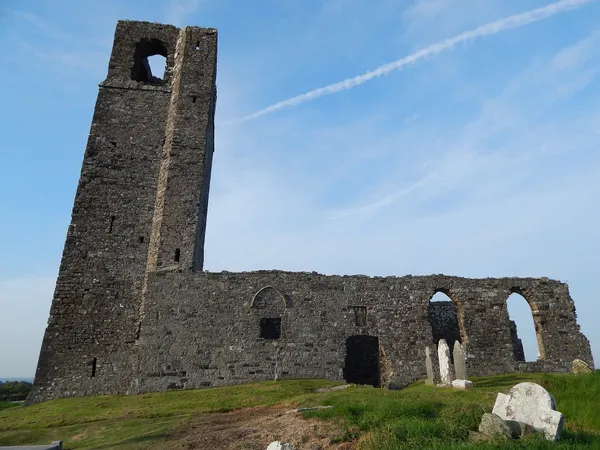
The ruined church at the summit, known locally as The Steeple or Skryne Tower, has a nave, a chancel and a tall tower at its west end. It began as an Augustinian foundation established by Francis de Feypo in 1341; most of the standing fabric, including the tall west tower, is 15th-century work. Inside are pointed medieval arches, a fragment of a baptismal font and part of a tomb slab. Above one doorway a weathered carved figure is traditionally taken to be St Colmcille. A carved late-medieval stone cross with a crucifixion carving stands nearby.
Lower down the hill is Skryne Castle, a much-altered tower house with a Georgian block added around 1780 and Gothic windows in the 1830s. It is privately owned and not open to visitors, so please leave the castle and the neighbouring grounds undisturbed.
The ghost of the castle
Local tradition tells of Lilith Palmerston, said to have been a young woman murdered on the estate in the 1740s and to walk the grounds on moonlit nights. It is a village story rather than documented history.
What to see and do
- The church and tower. Follow the signs at the site, give graves space and keep clear of unstable stonework. Check the Boyne Valley guide for current access information before you go.
- The view. The summit is open on all sides, with the Boyne Valley countryside spread out below; on a clear day Tara is unmistakable across the valley. Early morning and late afternoon light suit the tower and the ruins best.
- A quieter Boyne Valley stop. Skryne sits close to Bective Abbey and Brú na Bóinne, and slots easily into a day taking in the bigger sites.
Getting there and practicalities
Plan your route and parking in advance using the Boyne Valley heritage guide and local signage, and respect the village and its residents when you park. The hill is also popular with local walkers, so take care on the paths and keep to the way that is signed. Wear sturdy shoes for loose stone and old paving near the ruin, and be aware that the ground near the church is uneven and not suited to wheelchairs or buggies.