
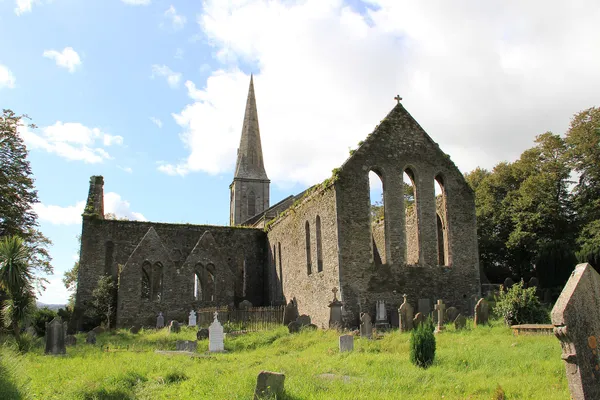
A ruin and a working church on one site
St Mary’s stands on a rise over the east bank of the River Barrow in New Ross, and the reason to climb up to it is the medieval half: a roofless 13th-century chancel and transepts, largely intact, with a collection of medieval funerary monuments. The neighbouring Church of Ireland building dates from 1813 and was altered later in the nineteenth century. It occupies the footprint of the old church’s nave right beside the ruin, and the medieval end is where you’ll spend your time.
Marshal’s church
William Marshal, 1st Earl of Pembroke, and his wife Isabel de Clare, daughter of Strongbow, built New Ross and its church together, completing St Mary’s in 1210 in sandstone and imported Dundry stone from near Bristol. Local tradition puts an earlier monastery here, attributed to Saint Abbán in the 6th century, though the standing building is firmly Norman.
The centuries were hard on it. The bells were stolen in 1654 during the Confederate Wars. By 1813 the great west aisle had been pulled down to make room for the present nave, with a spire added in 1870. The medieval eastern arm was left alone, and that neglect is why the stonework survives.
What to see in the chancel and transepts
From Church Street, look for the tall medieval window openings and the later church’s stone tower and spire. The east-facing chancel is the heart of the ruin: three lancet windows, and the fittings a medieval church needed for the Mass, including an aumbry, sedilia, piscina, and a carved tomb canopy. Among the floor slabs, look for a cross carved with the Agnus Dei (Lamb of God), a motif tied to the Knights Templar. Marshal fought alongside the Templars, and a Templar settlement operated nearby at Temple Town on the Hook.
The north and south transepts hold funerary monuments spanning the 13th to 17th centuries, remembering the Dormer, Archer, Roth, Butler and Devereux families among others. In the north transept, look for faint medieval graffiti scratched into the plaster, including a tiny ship. The south transept has a finely carved 13th-century male effigy in Dundry stone and a rare double marriage slab, showing one woman laid to rest beside both of her husbands.

The crypt and graveyard
Beneath the south transept is the crypt, the only roofed part of the medieval church. Its two vaulted chambers still show the curved imprints of the wicker-work centring the masons built the vaults over. The medieval markers are long gone; what’s left are 19th-century monuments to the Nixon, Tyndall and Cherry families. For a spell the crypt was used as a coal bunker before being restored. The graveyard outside shifts in mood over the centuries: earlier stones carry skull-and-crossbones memento mori, while later Victorian ones turn to scriptural scenes.
Legends
The stonework has always fed local storytelling. One tale tells of a “Black Hole” under an arch, where a soldier went in with his dog and only the dog came out. Another has a thief die in the act of prising a cross from the chancel. A cenotaph inscribed Isabel Lagen marks the tradition that Isabel de Clare’s heart is buried here, tying the ruin to one of the most powerful women of Norman Ireland.
Practical information
- Getting in: The ruins are known for their carved grave slabs, but access to the interior is not guaranteed. Ask at the local visitor information office about current access before making a special trip to see them. Respect closed gates and any signs for services or burials.
- Accessibility: The ruins, transepts and crypt have steps and low doorways, and the site is on a hill above the quay, so allow for an uphill walk back from the riverfront.
- Parking: Check local signage for parking on the surrounding roads.
Nearby
St Mary’s is a short walk from the town centre and the Kennedy Bridge. For a longer visit, return towards the riverfront for the Dunbrody Famine Ship. With more time, drive out to Ferns for its cathedral and castle, or south to Duncannon for the fort and coastal walks. The River Barrow Blueway runs close by for walking and cycling.