
Overview
The site is in the townland of Toureen, at the eastern end of the Glen of Aherlow under the Galtee Mountains in County Tipperary. The Office of Public Works records the church and its connection to the holy well.
Getting there is half the character of it, but it needs care. The OPW notes that the approach crosses a working farmyard and a railway level crossing. Confirm permission before entering the farmyard, follow the instructions at the railway crossing and leave farm entrances clear.
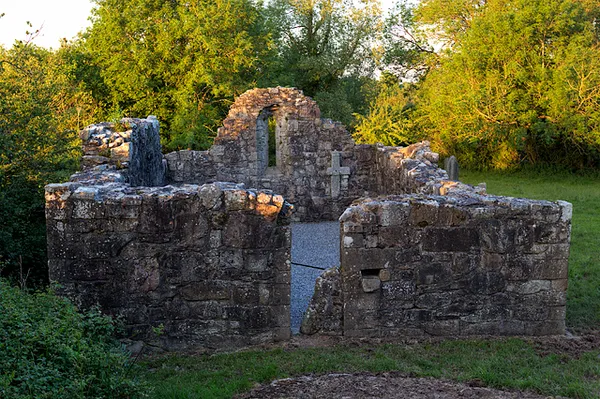
The well itself is a roughly circular, stone-lined pit set flush with the ground, with two shallow steps down to cold, clear water. Around it are the ruins of St Pecaun’s church, a beehive-style cell and several early-medieval cross-slabs.
History and the monastic complex
The settlement is traditionally dated to the seventh century. It’s named for St Beccan – Peacaun – after whom the well and site are called; some accounts credit the foundation itself to an earlier figure, St Abán, and the exact founder is not fully settled. The modest early church was later replaced by a more substantial Romanesque one, marked by heavy cyclopean masonry and cut stone windows.
North of the well lies a bullaun stone, on its side, with a hollow worn into each of two sides; it was brought here from the neighbouring townland of Ballydrehid, as was the millstone that sits further north again. These worn hollows were used in prayer rounds and, in local lore, tied to butter-making.
The butter turns up in the best of the legends: a woman who hid a lump of butter from St Pecaun found, when she went back for it, that it had turned to stone. Another old tale, still remembered locally, holds that a stone thrown into the well can put out a fire.
Pattern day and local traditions
The pattern day traditionally falls on 1 August – the day pilgrims have long come to pray, say the rosary and take a sip of the well water; some sources put the gathering on the first Monday of August. The site drew people from across the glen, especially in the first week of August, and the custom of drinking three sips while making the sign of the cross has long been kept. Many locals also ‘do the rounds’ in the first week of each month, a short circuit of prayers and a sip of water. If you want to join in, ask locally first, as the site is reached across private land.
Walking and getting around
For a public walk in the glen, choose one of the marked Glen of Aherlow loops from a designated trailhead rather than crossing farmland. The Glen of Aherlow has family-friendly loops such as the Ballinacourty Loop and the Woodland Loop, while stronger walkers can take the Galtymore route in the Galtees. Two quiet parallel roads run the length of the glen for cyclists, and the River Aherlow holds trout and perch (permit required).
Visiting information
- Access: the route crosses a working farmyard and a railway level crossing. Confirm permission before entering the farmyard, follow the crossing instructions and leave farm entrances clear. See the OPW page before you go.
- Getting there: from Cahir, head west and follow the N24, then the local roads towards Toureen.
- What to bring: sturdy footwear for uneven ground and stone steps. Check locally for facilities, as none are described at the site.
- Accessibility: not wheelchair-accessible, due to the terrain and steps.
Nearby attractions
- Athassel Priory – a medieval monastic site a short drive north.
- Cahir Castle – a well-preserved 13th-century fortress on the River Suir, a good pairing for a longer day.
- St Berrihert’s Kyle – a 7th-century site in the glen.
- St Sedna’s Well – another early-Christian well a few kilometres east, worth combining with Clonbeg churchyard.
Come on a dry day, wear boots for the wet ground, and give the bullaun stone north of the well a look before you leave – it’s older than the church beside it.