
Overview
The Gearagh is a wetland on the River Lee near Macroom, two kilometres south-west of the town in County Cork. The river divides into a maze of narrow channels and low wooded islands – oak, ash, hazel and hawthorn – of a kind that once lined river valleys across Europe. Then, in the 1950s, much of it was flooded when the Lee reservoirs were built.
The Irish name, An Gaorthadh (also given as An Gaoire), means roughly “the wooded river.” It is protected several times over: a Ramsar Wetland of International Importance since 1990, a Special Area of Conservation, and a 300-hectare statutory nature reserve.

History and conservation
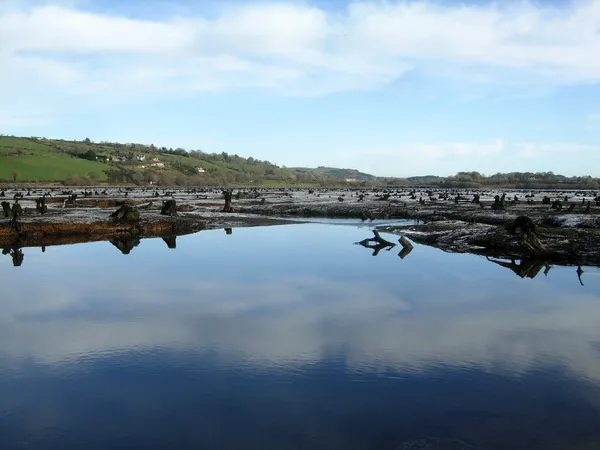
The plain began forming around the end of the last Ice Age, when meltwater filled the Lee valley and oak and ash took root on the islands between the channels. That woodland lasted thousands of years. It ended in the 1950s: the ESB built the Carrigadrohid and Inniscarra dams for hydroelectric power, and when the reservoirs filled in 1954 they submerged much of the Gearagh, killed part of the old oak woodland and forced families off the land they had farmed among the channels.
The ecological loss drove the campaign that eventually protected what remained. The Gearagh became a statutory nature reserve in 1987 and a Ramsar wetland – reference 472 – on 30 May 1990. The 300-hectare reserve sits within a wider 558-hectare Special Area of Conservation. It is owned by the ESB and managed with the National Parks and Wildlife Service, and the reservoir itself is a designated wildfowl sanctuary.
The channels still hold rare life: mudwort (Limosella aquatica); otters and kingfishers; the critically endangered freshwater pearl mussel; and the white-clawed crayfish. In spring the islands fill with wild garlic.
What to see and do
A flood-prone reserve
The National Parks and Wildlife Service describes frequent flooding and difficult access. Keep out of the channels and off flooded causeways, and do not treat the reserve as a place for a casual stroll. The ground is naturally wet and uneven, with exposed roots and soft earth.
Wildlife and nature
- Birdwatching: kingfishers, grey herons and water rail are resident. From October the channels fill with swans, wigeon and greylag geese.
- Flora: spring brings wild garlic and marsh marigold along the banks; low summer water exposes the old oak stumps.
- Leave it undisturbed: keep clear of nesting birds and otter holts, and leave wetland vegetation as you find it.
Two footnotes to the place, both from local tradition: the maze of channels made the Gearagh a favourite haunt of poitín makers, who could work unseen among the islands, and folklore blames the Meascan Maraiocht, mischievous spirits, for turning visitors around in circles.
Practical information
- Entry and access: there are no facilities, so bring water, snacks and a bag for your litter. Access is difficult; read the NPWS page before you plan a visit.
- Parking: we do not recommend informal roadside parking. Do not block gateways or narrow roads.
- Accessibility: the natural, uneven, often wet ground means the area is not suitable for wheelchairs or pushchairs.
- Water levels: the Gearagh changes completely with rainfall and dam releases. Wet spells widen the channels and shrink the islands; dry spells expose large stretches of lakebed, water-lily beds and stumps.
- Safety: water can rise fast after heavy rain. Stay off low causeways if the water looks deep or fast-moving.
Getting there and nearby
The reserve is best reached by car. From Cork city, take the N22 west to Macroom. There is no public transport to the reserve itself, so it is a car or a taxi from Macroom.
For a marked woodland outing instead, check Coillte’s Gougane Barra Forest Park and choose a trail suited to the weather.
Macroom has cafés, pubs and places to stay close by. A little further on, Ballyvourney sits in the Muskerry Gaeltacht, where Irish is still an everyday language.
Best time to visit
Spring and late summer show completely different places. In April and May wild garlic scents the whole wood. Come in a dry spell in late summer and the water drops back, lifting the black oak stumps – some of them thousands of years old – out of the mud across the reservoir. Autumn adds muted colour along the water; winter strips it to the bare geometry of channels and stumps. Water levels swing with the weather and flooding is frequent, so check the NPWS site before you travel.