
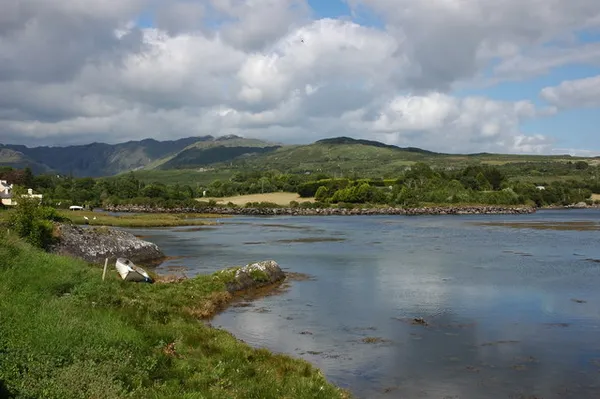
Adrigole
The Irish name Eadargóil means ‘between two inlets’, and that is more or less how the village sits: spread thinly along the sheltered north-western shore of Bantry Bay, with the Caha Mountains at its back. It is a working coastal place rather than a tourist set-piece, gathered loosely around the junction of the R572 and R574. The R572 links the village with Glengarriff and Castletownbere. Most people pass through on the Beara Way or the Ring of Beara and stop for the harbour, the hill, or the gallery.
Hungry Hill and the Mare’s Tail
Hungry Hill, at 687 m, rises above the village in the Caha range, and its climb is the main reason walkers come to Adrigole. On a clear day the summit gives you views over Bantry Bay and the length of the Beara Peninsula. Below the top is the Mare’s Tail, the waterfall that tumbles from the hill. Hungry Hill is a serious hill walk: the ground is boggy in stretches, the cloud comes down fast, and the weather can change quickly. Wear proper boots, carry a map and check the forecast. Use waymarked routes and public rights of way, and do not cross farmland without permission.
The hill lent its name to Daphne du Maurier’s 1943 novel Hungry Hill, which drew on the copper-mining families who once worked these slopes. Their shafts and engine houses scarred the hills through the 19th century.
The Beara Way
The Beara Way crosses the parish and loops the peninsula, forming one leg of the longer Beara-Breifne Way tracing O’Sullivan Beara’s 1603 march north. The Sport Ireland trail listing has route maps and grades the full route strenuous. The Beara-Breifne Way publishes a trail map through Adrigole village. Plan your return before walking a section, and leave dogs at home.
Much of the surrounding bog is a Special Area of Conservation, taking in Hungry Hill Bog, Leahil Bog and Trafrask Bog. Watch for buzzards working the updrafts; otters use the wetlands, though you will be lucky to see one.
On the water
The harbour is a sheltered inlet, long used by local fishermen and now home to West Cork Sailing, which offers kayak hire at Adrigole Harbour. Check conditions and availability with the centre before you set out, as times shift with the weather and tides. Harbour seals use the inlet, so give them space, particularly if they are resting on rocks or the shore.
Village life
Adrigole Arts is housed in a converted farmhouse looking out to the mountains and the sea, and shows local ceramics, paintings, textiles and jewellery. Check opening times before you go. The GAA club, modest by most measures, took the Cork Intermediate Football Championship in 1979 and the Junior title in 2006.
The village also carries a hard memory. In March 1927, Daniel O’Sullivan, his wife and their two children were found starved to death at Clashduff nearby, a death that moved Peadar O’Donnell to write his play Adrigoole (with the setting shifted to Donegal). A memorial at Trafrask honours five Sullivan brothers lost when their US Navy ship was torpedoed in the Second World War. Older still is the Leitrim Beg wedge grave east of the village, a prehistoric tomb sitting in a working farmer’s field. It is on private land, so do not enter the field without the farmer’s permission.
The beach
Adrigole’s pebble beach is at Trafrask, on the Glengarriff side of the village. It is a spot for a walk and a look at the bay rather than a bucket-and-spade day. Check the signs and local advice on access and parking before you go.
Where to stay
For a base, look at the villages around the bay: Castletownbere and Glengarriff both have a wider choice of hotels and B&Bs, and there is local accommodation closer to Adrigole. Check current availability before you travel.
Getting there and practicalities
Adrigole is on the R572, between Glengarriff and Castletownbere. If you are travelling by bus, check Bus Éireann route 236 for the services that stop in Adrigole. Check current parking arrangements near the harbour and trailheads before you go. The hills, harbour and trails can be visited year-round, though autumn brings the best light and the fewest people. Pack a waterproof and boots whatever the month, because the Atlantic weather here turns quickly.
For an industrial-heritage detour, the Allihies Copper Mines further west explain the 19th-century workings that shaped this whole stretch of coast.