
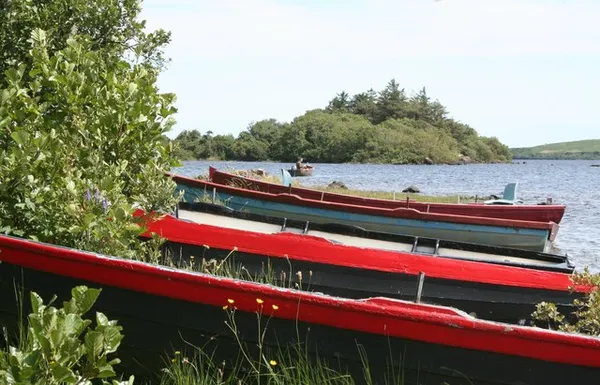
The lough
Corr na Móna, or Cornamona, is an Irish-speaking village on the north-western shore of Lough Corrib in Joyce Country, County Galway, with the Maam Valley rising to the west. Corr na Móna is the only official name; the anglicised Cornamona has no legal standing, though it’s what you’ll see on most signs and maps. The water is the main landmark, with islands offshore and the hills of west Galway behind the village. It’s a small place, and it works best as a base for the water and the hills rather than a destination in itself.
If you’ve only twenty minutes and no rod, the Corr na Móna viewpoint on the R345, on the shore of a small bay, gives a long view across Lough Corrib and its scatter of islands.
Fishing on Lough Corrib
Lough Corrib is a well-known wild brown trout fishery, and Cornamona is one of the places from which anglers go out on it. The classic window is the mayfly hatch in late spring, but trout come to wet flies, buzzers and dapping from spring through autumn, and salmon and sea trout run the inlets and river mouths too.
Rules differ between the lough and its tributaries, and a State licence is required for salmon. Inland Fisheries Ireland lists Cornamona angling guides and boat hire, and its Corrib catchment regulations set out the species, season, methods and permissions that apply to the water you intend to fish. If you don’t know the water, a day with a local ghillie and a traditional lough boat is money well spent, because reading the wind and the drift on a lake this size is a skill. Arrange a boat with an operator and check the weather before going out.
The lime kiln and other landmarks
The village’s most visible relic is the Cornamona lime kiln, a large early nineteenth-century kiln beside the river and bridge, recorded by Galway County Council. Quicklime from kilns like it sweetened acidic soils, went into mortar and made whitewash: the everyday chemistry of rural life before bagged fertiliser. View it from a public place and respect private land rather than climbing to it. In the village itself there’s a rock outcrop of Dalradian marble, a small geological signature of the wider Joyce Country and Western Lakes Geopark that the area belongs to.
Walking
Galway County Council’s walking guide lists the Sean Bhóthar route between Cornamona and Clonbur, an old road route near the lake shore. Check the mapped route and any access notices, and plan your return if you walk it one way.
The summit of Mount Gable (Benlevy) lies nearby, with views over both Lough Corrib and Lough Mask. More serious hillwalkers use the village as a jumping-off point for the Maumturks, where local guided operators run treks over peaks such as Maumeen and Binn idir an Dá Log, across peat bog and quartzite ridge. These want sturdy boots, good navigation and booking ahead.
Culture and community
The pub is the social centre, and traditional sessions of fiddle, box and bodhrán turn up from time to time. Irish is the language of the place and visitors are taken as they come. Cornamona was a main location for Foscadh (2021), the award-winning Irish-language feature about Gaeltacht life. The local secondary school is Coláiste Naomh Feichín.
Getting there and practical information
Cornamona is signposted north from Maam Cross, on narrow roads with single-track stretches typical of rural Galway, so take it steady. Public transport is thin, so a car is by far the easiest way in; check current services before relying on a bus.
- Fishing – check Inland Fisheries Ireland’s guidance for the water you plan to fish, and note that salmon need a State licence.
- Guided walks – contact local operators ahead for the off-trail mountain routes; rates and dates vary by season.
- Accommodation – the village has little of its own, so most visitors stay in Clonbur, Leenane or Letterfrack.
Nearby
- Lough Nafooey – a glacial lake in the next valley west, with a sandy shore and red volcanic rock.
- Clonbur – native woodland and limestone pavement between Corrib and Mask, near Caisleán na Circe, the island castle tied to Grace O’Malley.
- Connemara National Park – further south, protecting the Twelve Bens, megalithic tombs and blanket bog.
- An Spidéal – another Gaeltacht village, on Galway Bay, known for its craft workshops.
Time a visit for late spring and the lough does the rest: the trout come up to the mayfly, and every boat on the water will be out after the same rising fish.