
Overview
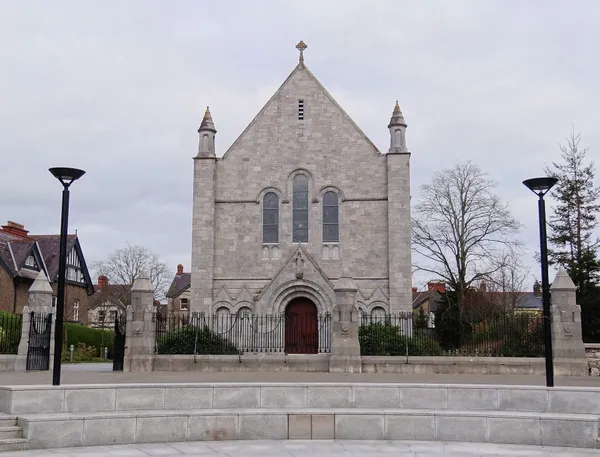
The Honan Chapel holds eleven stained-glass windows by Harry Clarke, in a building small enough to take in over a coffee break. It sits on the University College Cork campus above the River Lee, an active Catholic chapel that doubles as a near-complete museum of the Celtic Revival and Arts and Crafts movements. Designed in 1914 by Cork architect James F. McMullen and built by John Sisk & Son, it turns its back on ornate continental styles for plain Hiberno-Romanesque: austere stone walls, a timber barrel-vaulted ceiling and a round bell tower borrowed from Ireland’s early monasteries.
It is a working place of worship, so visiting depends on what is happening inside. Entry to the chapel is free. Check the chapel’s website for current visitor and service arrangements before you go.
A chapel forged in Ireland’s Arts and Crafts movement
The chapel filled a long gap. When Queen’s College Cork was founded in 1845, funding rules barred religious buildings on campus, leaving Catholic students without a chapel. That changed when Isabella (Belle) Honan, heir to a wealthy Cork merchant family, died in 1913 and left £10,000 for a Catholic place of worship for the university’s scholars.
Dublin solicitor and arts patron John O’Connell took charge of the Honan Fund, and he had a clear line: the chapel should be “something more than merely sufficient,” in the spirit of the churches built by Ireland’s early missionaries. Working with UCC President Sir Bertram Windle, he insisted that the materials come from the city or county of Cork and that local craftspeople do the work. The foundation stone was laid on 18 May 1915 and the chapel consecrated on 5 November 1916 – built during the First World War and the year of the Easter Rising, which gave it an immediate charge as a statement of Irish identity and craft.
What to see inside
The stained-glass windows
The chapel’s nineteen windows are a rare concentration of early Irish glass. O’Connell first meant Sarah Purser’s Dublin studio, An Túr Gloine, to supply them all – but after seeing a cartoon for the St Brigid window he handed the commission to the 21-year-old Harry Clarke. Clarke designed eleven windows in the end; An Túr Gloine made the other eight.
Clarke’s panels run along the west gable and the nave. The Triadis Thaumaturga trio above the entrance shows Ireland’s patron saints – Patrick, Brigid and Columcille – in his mix of Catholic iconography, Art Nouveau line and early Celtic motif. Look for the deep blues and greens of the specially ordered antique pot-metal glass, the small border creatures, and the Irish detail: Brigid’s spiralled headdress, Brendan’s pampooties. His St Gobnait, patron saint of bees, is an ascetic figure framed in royal blue and purple.
The eight An Túr Gloine windows, by A.E. Child, Catherine O’Brien, Ethel Rhind and others, are a deliberate contrast – more naturalistic and restrained, in softer palettes. Child’s Our Lord window above the altar keeps its tones muted to hold the eye on the central figure. A restoration in 2022 cleaned and re-leaded the glass and storm-proofed the building.
The River of Life mosaic floor
The mosaic floor, designed by Ludwig Oppenheimer, runs as one continuous narrative of creation and resurrection, in four sections tied together by interlaced Celtic and zoomorphic borders. From the western entrance, a sunburst ringed by the signs of the zodiac stands for God’s dominion over time. Moving east, the floor opens into the jaws of a beast forming a river where fish swim toward the chancel; the eastern nave carries a great coiled sea creature – part serpent, part dragon, part whale – with the Latin dracones et omnes abyssi (“dragons and all the depths”), read in medieval exegesis through the story of Jonah as a triumph over death. The chancel shifts to a quieter palette, a paradise landscape of stags, birds and seasonal motifs.
Stone carving and furnishings
The stonework was carved by Henry Emery with students from the Cork School of Art. The capitals over the five western arches carry lozenge and pellet decoration; those on the limestone ribbed vaults bear portraits of six Munster saints – Finbarr, Coleman, Gobnait, Brendan, Declán and Íte. The tympanum over the main door, by Oliver Sheppard, holds a statue of St Finbarr in bishop’s vestments.
Inside, the furnishings keep the Arts and Crafts insistence on handwork. The original limestone altar was replaced in the 1980s, after the Second Vatican Council asked that clergy face the congregation; Imogen Stuart designed the current oak altar, pulpit and font. The tabernacle at the end of the chancel is the set piece, its silver-gilt branches and enamel work by Oswald Reeves showing the Trinity and the Lamb of God against deep blue.
Visiting and services
The Honan is a working campus chapel, not a museum. Check the chapel’s website for service and visitor arrangements before going, and give people attending worship or ceremonies space. It is also used for weddings and university ceremonies.
Practical tips:
- Approach: use the public campus approach and follow local signs.
- Photography and tours: ask the chapel about its rules for photography and for guided visits before you plan around either.
Getting there and nearby
The chapel is in the middle of the UCC campus, an easy walk from the main quads or Western Road. Check current bus and parking arrangements before you travel.

If you have time to pair it with something, the Doneraile Estate – Georgian house, deer park and formal gardens – is about 40 minutes’ drive north.
Start at the west gable: the Triadis Thaumaturga windows over the door – Patrick, Brigid and Columcille – are the place to begin.